Solar permits and interconnection are the part of going solar that nobody shows you in the brochure. The panels go up in a few days, but the paperwork around them can take weeks or even months. Understanding what happens, and who is responsible for each step, saves you a lot of frustration.
I’m a solar installer based in Valencia, Spain, so I know this side of the job from the inside: in my experience, the legal paperwork is often the slowest part of an installation. The rules below are for the United States and the United Kingdom, based on official and industry sources, and I’ll tell you where my own experience adds something.
Solar permits and interconnection: what is the difference?
They are two separate approvals, and you usually need both:
- Permits come from your local government. They confirm the installation is safe and meets building and electrical codes.
- Interconnection comes from your electricity company. It confirms your system can be safely connected to the grid.
In most cases your installer handles both, but it still helps to know what is going on.
Solar permits and interconnection in the US: the steps
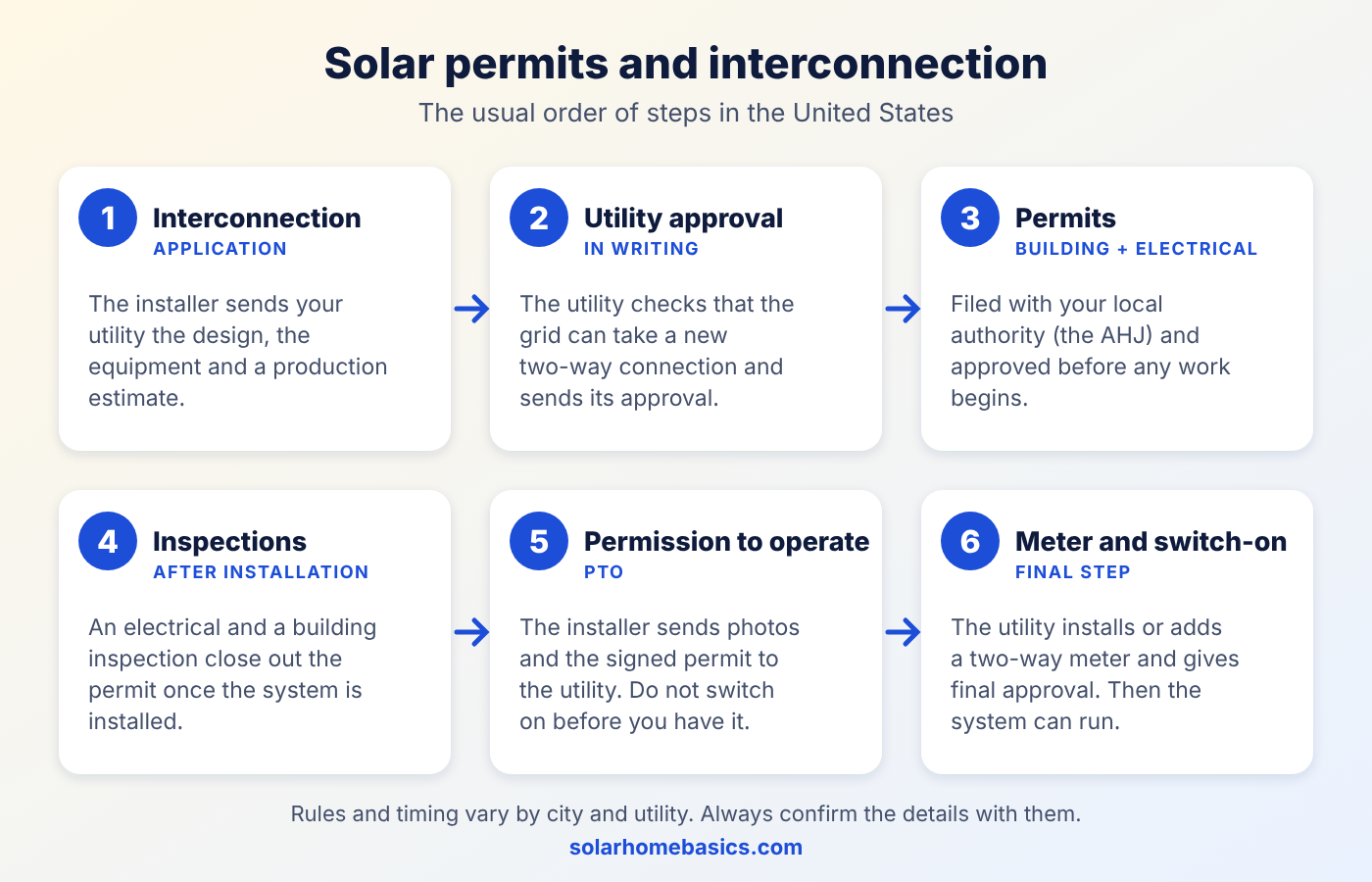
The exact process changes by city and utility, but this is the usual order:
- Interconnection application. The installer sends your utility the property details, system size, equipment, electrical diagrams and a production estimate. The utility checks whether the local grid can handle a new two-way connection.
- Utility approval. Once any issues are solved, the utility sends written approval so installation can go ahead.
- Building and electrical permits. These are filed with the local authority, known as the AHJ (authority having jurisdiction), and must be approved before installation.
- Installation and inspections. After the work, an electrical inspection and a building inspection close out the permit.
- Permission to operate (PTO). The installer sends the utility photos of the installed equipment and the signed electrical permit. The utility may do its own inspection, but for many home systems the documents are enough.
- Meter and activation. The utility installs or adds a meter that tracks the power you import and export. Only after final approval can you switch the system on.
This is why a finished system can sit on your roof waiting for approval. Do not switch it on before you have permission to operate.
How long do solar permits and interconnection take?
There is no single answer. The National Renewable Energy Laboratory notes that review and approval can sometimes add weeks or months to an installation, and the home builders’ association describes the interconnection process as taking anywhere from several weeks to several months, depending on system size and how efficient the utility is.
Some places are much faster. A US government tool called SolarAPP+ automates permit approval in the communities that use it. The Department of Energy reported that projects in those areas were about 13 business days faster than with traditional permitting, and about 29% less likely to fail inspection. Ask your installer whether your city uses it.
Solar permits and interconnection in the UK: G98 and G99
In the UK, the electricity network operator (the DNO) must know about your system:
- G98: for inverters up to 3.68 kW per phase, which covers most homes. It is a notification you send within 28 days after commissioning.
- G99: for larger systems (above 3.68 kW per phase, or 11.04 kW on three-phase). It needs approval first, which typically takes around four to eight weeks, and the installer normally submits it.
You also need an export meter point reference number (MPAN) before you can join an export tariff. For the rates themselves, see our guide to the Smart Export Guarantee and the British Gas export tariff.
What I give customers when the job is finished
At the end of an installation, I give the customer everything I worked on and installed, together with an approximate estimate of the energy performance. I also give them a copy of all the paperwork, except the confidential documents, and I tell them to keep it safe in case they need it in the future.
I would ask for the same from any installer, wherever you live. A folder with your documents makes selling your home, claiming a warranty or dealing with your insurer much easier.
Questions to ask your installer about solar permits and interconnection
- Who files the permits and the interconnection application, and is it included in the price?
- How long do they expect approval to take in my area?
- When will I get permission to operate, and when can I switch the system on?
- Will I receive copies of all the approved documents?
Add these to the questions in our guide to comparing solar quotes. To see how the paperwork fits into the whole job, read how long a home solar installation takes. If your system is limited to zero export, the approval steps matter even more, as we explain in how zero-export solar works.
Sources and where to check the latest rules
Rules vary by local authority and utility, so confirm the details with them. These sources were used for this guide:
- NREL: solar permitting, inspection and interconnection timelines
- US Department of Energy: SolarAPP+ annual report
- NAHB: solar interconnection process
- Sunsave: G98 and G99 applications
Frequently asked questions
Do I need a permit to install solar panels?
In most places, yes. Your installer normally files it with your local authority before installation.
What is interconnection?
It is your utility’s approval to connect your system to the grid.
Can I switch on my solar system as soon as it is installed?
Not in the US: wait for the permission to operate. In the UK, G98 systems are notified after commissioning, but G99 systems need approval first.
Who handles the paperwork?
Usually your installer. Ask for confirmation in writing, and keep a copy of every approved document.